How we judge
How to judge 3PL software before you build a shortlist

To judge 3PL software, decide what matters before any demo: write down what you do, weight seven areas from 0 to 5 and score each product. Most shortlists start with names; this one starts with a sheet of paper. If you decide what matters before you see a single demo, the demos stop steering you.
Below is the method we would use to judge software for a third-party logistics operation. Use it as is, or cross out our weights and put in yours.
Step 1: write down what you actually do
Before scoring anything, fill in this short profile. It takes ten minutes and changes the whole result.
- How many client accounts do you serve today, and how many do you want in a year?
- Do clients ship their own inventory in, or do you buy and hold it?
- What do you bill for: storage, handling, pick and pack, special projects, freight?
- Which systems must connect: client storefronts, carriers, accounting, EDI partners?
- How many people use the system on a busy day, including temporary staff?
A 3PL with three large clients and a 3PL with forty small ones are shopping for different products. The profile tells you which one you are.
Step 2: score seven areas
Give each area a weight from 0 to 5 for how much it matters to you, then score each product 0 to 5 for how well it covers it. Multiply and add up. The sheet is deliberately simple so you can run it in a spreadsheet.
| Area | What to ask | Your weight (0 to 5) |
|---|---|---|
| Multi-client handling | Can each client have its own items, rules, locations and reports without separate setups? | |
| Billing | Can the system calculate storage, handling and special charges the way your contracts define them, or do you still export to a spreadsheet? | |
| Client portal | Can clients see stock and orders themselves, and what can they change? | |
| Integrations | Are your exact connections supported, by name, and who maintains them? | |
| Floor usability | Can a new temp worker pick a first order after a short walkthrough on the devices you own? | |
| Reporting | Can you get the numbers you quote to clients without rebuilding them by hand? | |
| Cost over time | What does the total look like at your size now and at the size you want to be? |
Seven rows is enough. More rows make everything look equal, and a long sheet hides the two things that decide the outcome.
Step 3: ask for proof, not promises
For every area where you gave a weight of 4 or 5, ask the vendor to show it, not describe it. A useful test is a script of your own.
- Give them three of your real contract rules, with client names removed.
- Ask them to set those rules up live, or on a recorded call.
- Ask them to run one inbound shipment and one outbound order through the setup.
- Ask to see the invoice line the system would produce.
If a vendor says "we can configure that", ask who configures it, how long it takes and whether it costs extra. The answer is often more useful than the demo.
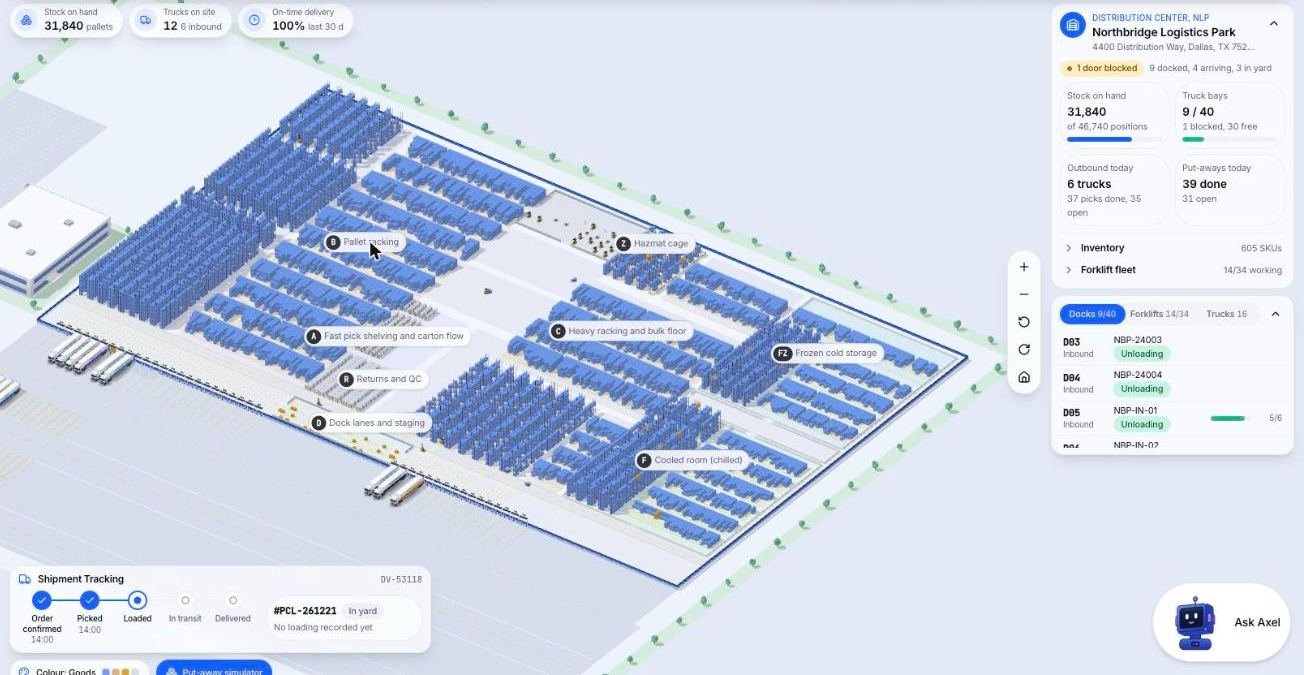
Here is an example of a screen you might ask a vendor to show you for floor visibility. It comes from the Microsive demo platform and uses demo data.
Step 4: check the things nobody puts on the slide
- Data export. Can you get all your data out, in a usable format, if you leave?
- Who holds the keys. In a hosted product, who controls updates and downtime windows?
- Change requests. When you need something unusual for one client, what is the route and the usual wait?
- Support hours. Does support match your shift pattern, including weekends if you ship then?
- Exit terms. What are the notice period and any minimum commitment?
None of this is exciting. All of it is what people mention a year in.
What different 3PLs should weigh
These are tendencies, not rules.
A new 3PL with a few clients. Speed of setup and simple billing usually matter most. You do not yet know what your edge cases are, so avoid anything that needs a long project before the first order ships.
A growing 3PL adding clients quickly. Pay attention to how the price behaves as accounts and users increase, and to how fast a new client can be onboarded. Onboarding time is a hidden cost that grows with every client.
A 3PL with a few large, complex clients. Rule depth and integrations carry the weight. One client with unusual labelling or EDI requirements can outweigh everything else on the sheet.
A 3PL that is considering a custom build. Everything above still applies, but add two questions: who owns the code and data, and who supports it later. A custom build can be a fair option next to subscription software, and Cargohold, which we make, is a one-time custom build, no per-seat, per-truck or per-client fees. Score every option on the same sheet.
Example: how scoring changes the answer
This is a made-up example, not a real company. A small 3PL runs ten clients, each billed on storage plus a per-order handling fee. Its owner gives billing a weight of 5 and the client portal a weight of 2, because clients currently email for stock levels and nobody minds.
Product A scores high on portal and low on billing. Product B is the reverse. On a gut-feel demo, A looks better because the portal is impressive. On the sheet, B wins, because billing carried more weight. The owner has not been tricked by a flashy screen. That is the point of the sheet.
Common mistakes
- Scoring before weighting. You end up weighting whatever your favourite product is good at.
- Letting one loud feature decide. A demo moment is not a requirement.
- Ignoring your own staff. Ask the people who will use the screens what they think after a trial run.
- Treating the shortlist as final. Run the proof test on two products, not six.
What comes next
Our list pages will use this exact sheet. When we add specific products, every fact will carry a public source and the date we read it, and you can swap in your own weights to reach a different order. If you disagree with a criterion, that is useful to hear.
Questions people ask
What should a 3PL software scorecard include?
Multiple client handling, billing, client portal, integrations, floor usability, reporting and cost over time.
How do I weight and score the sheet?
Give each area a weight from 0 to 5 for how much it matters to you, score each product 0 to 5, then multiply and add up.
How do I ask a vendor for proof?
Give them three of your real contract rules with client names removed, ask them to set them up and run one inbound shipment and one outbound order, then ask to see the invoice line the system would produce.
What do buyers forget to check?
Data export, who controls updates and downtime in a hosted product, how change requests work, support hours and exit terms.
Should I choose vendors before I build the scorecard?
No. Decide what matters before any demo so the demos stop steering you, then put the vendors on the sheet.
Sources
- No third-party vendor facts are used on this page. Criteria are our own working method. Any vendor-specific claim added later needs a public source and a fetch date.